

Why It’s Time to Revive FDR’s Economic Bill of Rights
In 1944, as the United States stood on the threshold of victory in World War II, Franklin D. Roosevelt delivered a State of the Union address that looked beyond military triumph toward the shape of a just and stable peace. Political democracy, he argued, was not enough on its own. True freedom required economic security. Out of that conviction he proposed what has come to be known as the Economic Bill of Rights—a framework of guarantees meant to ensure that every American could live with dignity, opportunity, and material stability.
Today, more than eighty years later, the case for promoting this vision is arguably stronger than ever.
1. Political Rights Are Fragile Without Economic Security
Roosevelt’s core insight was simple but profound: people who lack basic economic security cannot meaningfully exercise political freedom. The right to vote, speak, or organize loses substance when individuals are trapped in cycles of poverty, medical debt, housing precarity, or wage stagnation.
In the modern economy, millions work full-time yet struggle to afford rent, healthcare, or education. When survival consumes all energy, civic participation declines. Reviving the Economic Bill of Rights reframes freedom not merely as non-interference, but as the real capacity to participate in democratic life.
2. The Economy Has Outgrown New Deal-Era Protections
The original New Deal created Social Security, labor protections, financial regulations, and public works programs. These reforms stabilized capitalism in the 20th century. But the 21st-century economy—defined by automation, gig labor, AI displacement, and extreme wealth concentration—has outpaced those safeguards.
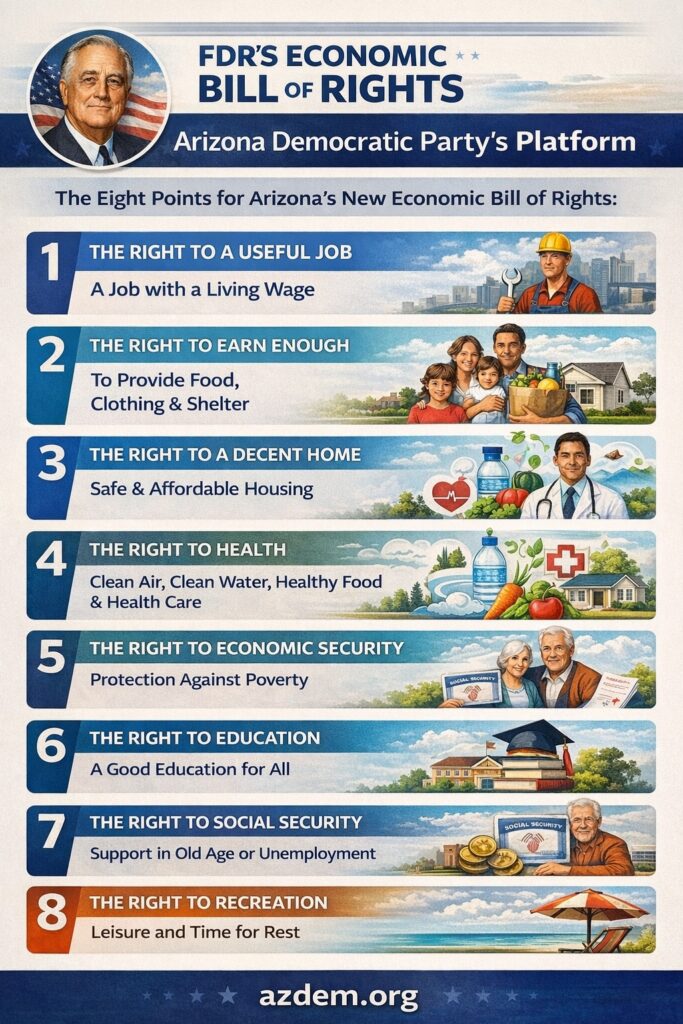
FDR’s proposed rights included:
- The right to a useful and remunerative job
- The right to earn enough for adequate food, clothing, and recreation
- The right to a decent home
- The right to adequate medical care
- The right to economic security in sickness, accident, old age, or unemployment
- The right to a good education
Far from outdated, these guarantees map closely onto today’s policy debates: living wages, universal healthcare, affordable housing, student debt relief, and job transitions in an automated economy. Promoting this framework provides a coherent moral foundation tying these issues together rather than treating them as isolated reforms.
3. Economic Inequality Threatens Social Stability
The United States is experiencing levels of wealth inequality not seen since the Gilded Age. Extreme concentration of wealth distorts markets, politics, and social cohesion. Research consistently shows that high inequality correlates with worse health outcomes, lower social mobility, higher crime, and declining trust in institutions.
FDR warned that “necessitous men are not free men.” When large segments of the population feel locked out of prosperity, resentment and polarization grow. An Economic Bill of Rights offers a stabilizing counterweight—ensuring that growth translates into broadly shared prosperity rather than elite accumulation.
4. It Strengthens Rather Than Replaces Markets
Critics sometimes frame economic rights as anti-capitalist. But Roosevelt himself saw them as necessary to save market democracy from its own excesses. The New Deal did not abolish private enterprise—it preserved it by creating guardrails that prevented collapse and mass suffering.
Promoting an Economic Bill of Rights today can be understood in the same spirit: not government control of all industry, but baseline guarantees beneath which no citizen should fall. Healthy markets require healthy consumers, educated workers, and stable communities.
5. Freedom Should Mean More Than Survival
America’s founding political documents emphasize liberty, equality, and the pursuit of happiness. Yet for many, life is reduced to economic survival—multiple jobs, no savings, precarious healthcare, and rising living costs.
An Economic Bill of Rights expands the moral meaning of freedom. It asserts that dignity requires more than formal rights—it requires the material conditions that make human flourishing possible.
This vision resonates across ideological lines:
- Conservatives often emphasize the dignity of work—economic rights ensure work pays enough to live.
- Liberals emphasize equity—economic rights establish universal floors.
- Libertarians value independence—economic security reduces coercion by desperation.
6. It Provides a Unifying National Narrative
Modern politics is fragmented into single-issue battles: healthcare, housing, wages, education, childcare. FDR’s framework weaves these into one coherent story: democracy must deliver economic security.
Promoting this narrative can reorient public discourse away from piecemeal technocratic policy fights toward a broader moral project—renewing the social contract.
7. It Reflects Widely Held Public Values
Polling across decades shows strong bipartisan support for many planks of the Economic Bill of Rights when framed individually:
- Protecting Social Security and Medicare
- Lowering prescription drug costs
- Investing in jobs and infrastructure
- Expanding access to education and training
- Ensuring fair wages
The political divide often lies less in ends than in means. Reviving FDR’s language helps articulate shared goals even amid disagreement about implementation.
8. The Post-War Precedent Still Inspires
The decades following World War II—when New Deal and post-New Deal policies were strongest—produced the largest middle class in human history. Wages rose with productivity, homeownership expanded, education access widened, and inequality shrank.
While many factors drove that prosperity, the policy architecture reflected Roosevelt’s economic-rights philosophy: growth paired with security.
Promoting the Economic Bill of Rights today draws on a historically grounded model of inclusive capitalism rather than an untested theory.
Conclusion
Reviving FDR’s Economic Bill of Rights is not about nostalgia—it is about unfinished work.
Roosevelt recognized that democracy must evolve alongside economic reality. Political rights secured the 18th century. Civil rights advanced the 19th and 20th. The 21st century calls for economic rights that ensure freedom is substantive, not symbolic.
At a time marked by inequality, precarity, and rapid technological change, promoting this vision offers more than policy proposals—it offers a moral framework for a society where prosperity, dignity, and democracy rise together.
The question is not whether we can afford such rights. It is whether a modern democracy can afford to flourish without them.
...